Ranch Gate Signs · buyer guide
Coordinating buildings and equipment identifiers
For worldwide Ranch Gate Signs orders, use building and equipment identifiers that map to stable property records, with separate counts for locations and movable assets. A building identifier points to a fixed location, while an equipment identifier follows a particular asset through changes in storage or use.
Reviewed 2026-09-05 · AI-assisted editorial review. General buying guidance; illustrative scenarios are not customer case studies. Images are AI-generated concepts.
Keep those roles separate in the ranch schedule. A tag that says Workshop should not become the identity of every item parked there. Ask the property manager which existing records supply the approved location and asset codes. The sign order should reproduce a chosen system rather than invent a parallel one from informal nicknames. Decorative identity labels also do not replace required manufacturer, safety or regulated markings. State the limited purpose of each new piece so a useful property-organizing project does not quietly overwrite another identification system.
How do you keep stable codes separate from friendly display names?
A property may use a familiar building name alongside a shorter internal code. Record both fields and decide which belongs on the physical sign. A building renamed for a new use can retain a stable record identifier if the manager’s system calls for that.
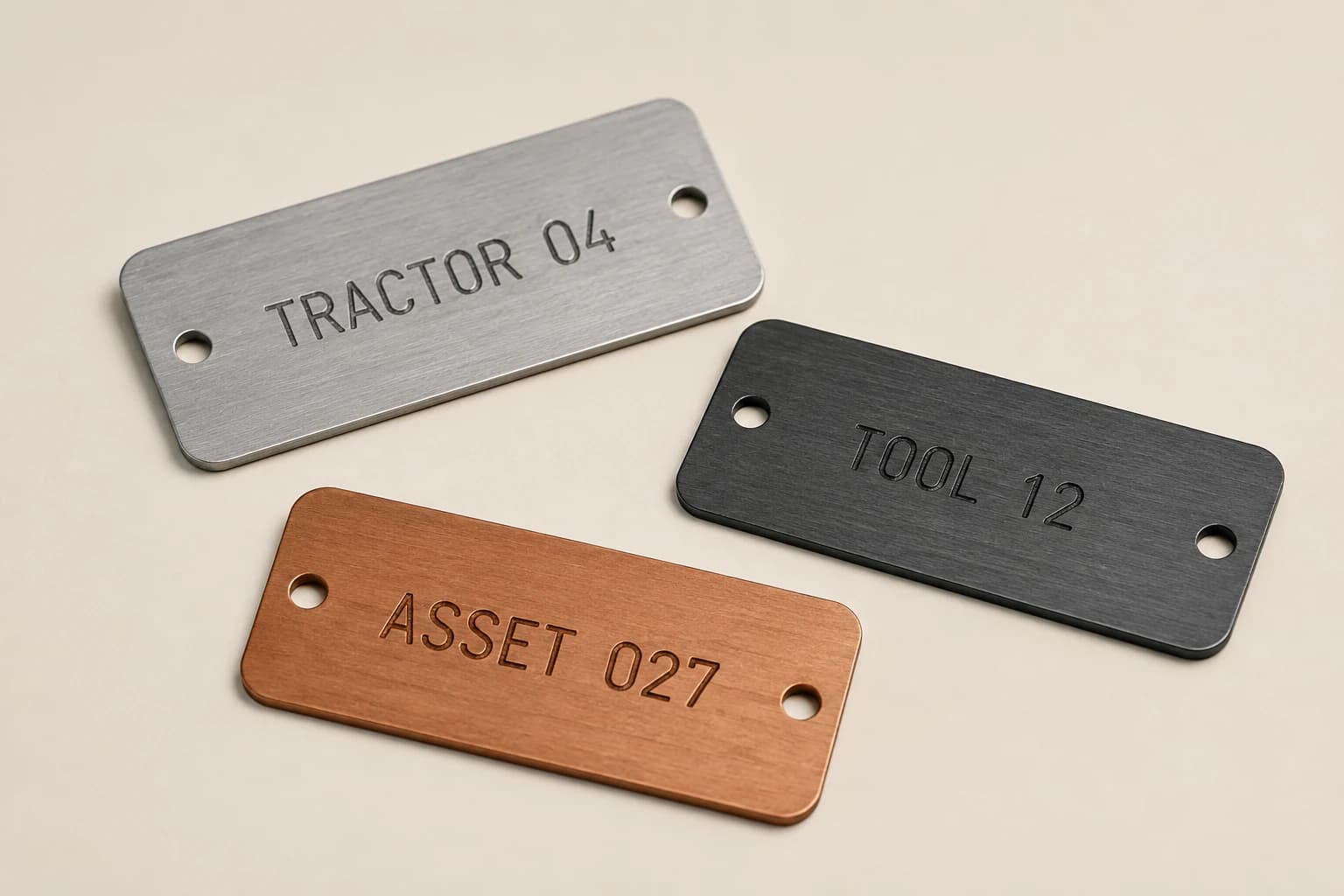
Equipment may likewise have an approved asset code plus a plain-language description. Do not use a changing storage location as the only equipment identity. Avoid exposing private ownership, contact or operational details merely because there is space on the tag. The useful public text is the minimum that serves the approved recognition task. Keep the richer asset record in the manager’s appropriate system with a clear link to the physical identifier.
Brady describes consecutive numbering as a use for its B-193 asset tags.

Sources: Brady: B-193 Property Nameplates Technical Data Sheet
How do you resolve duplicate codes before ordering physical tags?
Check the proposed code list against the property’s current records before formatting it for production. Two similar machines can need distinct asset identifiers even when their descriptions are identical. Conversely, the same asset listed under two storage locations may need one tag rather than two.
Ask the manager to resolve those cases explicitly. A calculator can add rows but cannot decide whether they refer to different physical assets. Preserve leading zeros and approved separators as text so spreadsheet formatting does not silently change the code. If an identifier is retired, keep its status visible in the record rather than assigning it to a new object without the manager’s deliberate decision.
How do you specify the actual label setting for each group?
Describe where each identifier will be used, what surface or holder is involved and which conditions the supplier should consider. A building sign and an equipment tag can share typography while needing different proposed constructions. Do not infer material suitability from a general ranch image or another merchant’s asset-tag category.
Have the responsible person review placement so the new identifier does not cover existing required information or interfere with equipment use. Any specialized attachment or environmental question needs project-specific assessment. Group pieces only when their relevant conditions and dimensions have been confirmed comparable. The quote should preserve differences that affect production even if all the identifiers belong in one property schedule.
How do you count identifiers by physical object and approved copies?
List each building, asset or shared location that actually needs a new piece. State whether it receives one identifier or multiple approved copies for different viewing positions. Do not multiply every equipment item by two simply because some buildings need two signs.
Retained usable identifiers should remain in the inventory but outside the new purchase count. A stored replacement tag needs a defined purpose and code; it is not automatically interchangeable with another asset’s tag. Use category rows for the calculator only after the detailed list has been checked. The grouped total should be traceable to actual objects, allowing a second coordinator to reconcile it without guessing which informal location names were included.
Total building, equipment and shared-location identifiers
Load the fictional example, then replace its inputs with the reviewed details for your project.
Method: Multiply each entered category’s object or location count by its pieces per item, sum the rows and add explicitly entered spares. This does not validate asset codes or detect duplicate records.
Build your plan
Use one row per tag type. For example: Valve labels | 20 | 2. Material, dimensions, legend text and mounting belong in the final tag schedule.
Use the article’s example files
Sample rows are illustrative and are not production instructions. Replace their assumptions, keep private records separately and complete the approval fields before using the sheet for a real order.
How do you release the code and description as a paired proof?
Give the reviewer a proof showing the identifier and any description together. A correct code paired with the wrong machine description can still mislead the reader. For building signs, check the location mapping against the manager’s current approved property plan.
If a code uses easily confused characters, review the actual typeface at the proposed size rather than changing the approved code silently. Any scanning or digital-link requirement needs its own specification and verification; a printed code is not proof of a functioning asset system. Keep the released data and layout tied to a version so a late description edit does not shift the row order and attach names to the wrong identifiers.
How do you reconcile installed identifiers with the property record?
At handoff, record which approved identifier reaches each building or asset. Do not mark the whole project complete merely because the carton total matches the purchase order. A misplaced tag can preserve the arithmetic while breaking the connection to the record.
Keep uninstalled pieces and exceptions separate until the responsible person resolves them. When equipment moves, update its location in the property record without changing the asset code unless the manager’s system requires that. When a tag is replaced, retain the same approved identity and confirm current construction needs. This makes the sign schedule a useful link between the physical property and its records rather than a one-time list of engraved words.
How does the illustrative coordinating buildings and equipment identifiers example work?
A fictional ranch’s reviewed list contains four building identifiers, nine equipment tags and two shared-location signs. Each approved object or location needs one new physical piece, and no spares are requested. The total is fifteen. The equipment codes stay with their assets when storage locations change.
The worksheet separates the three categories and leaves the real codes on hold until the property manager approves them. The category worksheet groups four buildings at one sign each, nine equipment assets at one tag each and two shared locations at one sign each. Four plus nine plus two equals fifteen physical pieces, with zero spares. The grouped calculator does not validate the underlying codes or identify duplicated assets. Complete the private item-level mapping before releasing the grouped quantities, and keep a moved machine’s asset code distinct from its new location.
Fixed building or shared-location sign or Movable equipment identifier: which fits this order?
Use fixed-location signs for buildings and shared places, and equipment identifiers for individual assets that may move. Both can share a visual style while connecting to different records. Compare the identity each piece preserves, its actual display conditions and the person who maintains the underlying location or asset information.
| Option | Fixed building or shared-location sign | Movable equipment identifier |
|---|---|---|
| Best reason to choose it | Choose this to identify an approved place whose record persists when its occupants or use change. | Choose this to identify a specific asset even when it moves between buildings or storage areas. |
| Main review question | Does the code and display name point to the intended fixed location in the property record? | Does this code uniquely map to the intended asset without replacing required existing markings? |
| What to specify | Specify the location reference, approved name, number of physical copies and proposed display conditions. | Specify the approved asset code, paired description, actual placement context and responsible record owner. |
| Later change | A building name change should follow the manager’s location-record decision and preserve the intended stable code where applicable. | An equipment move updates its location record; a replacement tag should preserve the approved asset identity and current placement requirements. |
What should you confirm before ordering?
Resolve the property’s code list before converting it into sign and tag quantities. A building identifier points to a place, while an equipment code follows an asset when it moves. Confirm the approved mapping, placement and record owner so fifteen delivered pieces can be reconciled with fifteen intended objects or locations.
How should building signs and equipment tags be quoted?
Request Ranch Gate Signs pricing by the actual construction groups and physical quantities, with code personalization, artwork, proposed attachment components and shipping identified. Buildings and movable equipment can need different formats despite shared typography. Ask for the range or minimum for each proposed group, and confirm the item-level code list before accepting a grouped quantity as final.
Should the equipment code change when it moves?
Keep the approved asset identity stable when that matches the property manager’s system, and update the storage location as a separate field. A machine remains the same asset when moved between buildings. Do not rename its tag after every move or use a current room name as its only identity without a deliberate system decision.
Can two identical machines use the same tag text?
They may share a description, but the manager should decide how each maps to a distinct asset record. If separate identification is the purpose, duplicate codes can undermine that connection. Resolve the underlying records before engraving. The calculator can total two tags without detecting that their identifiers accidentally refer to the same machine.
Do these tags replace existing equipment markings?
Treat the new pieces as the approved property-identification layer only. Do not remove, cover or reinterpret manufacturer, safety or regulated markings through this decorative order. Have the responsible person review placement and any specialized requirements. The brief should state what the added identifier communicates and where its associated property record is maintained.
How do we check the fifteen-piece sample at delivery?
Count four building identifiers, nine equipment tags and two shared-location signs, then reconcile each with its intended record or location. The total alone does not establish correct assignment. Keep uninstalled pieces and exceptions separate until resolved, and preserve the approved code-description pairing when the receiving person distributes the tags.
Sources and scope
The sources below support the cited technical details. The ordering workflows are editorial recommendations. Your project specification, price and schedule are established in the written quote and approved proof.
- Brady: B-193 Property Nameplates Technical Data Sheet · checked 2026-09-05
Which buying guide should you read next?
All buying guidesFor worldwide Ranch Gate Signs orders, count physical panels separately from printed or engraved faces when ordering double-sided ranch signs.
For worldwide Ranch Gate Signs orders, brief a new ranch sign around the measured existing gate and its reviewed operation before approving the decorative face.